
The Jobsite Nightmare: The 'Crowning' Ceremony
Walk onto any wood-framed job site in Southern California, and you will witness a universal ritual: carpenters standing over bunks of 2x4s and 2x6s, lifting each stick to one eye, sighting down the narrow edge to find the 'crown' (the high curve of the bow). The carpenter marks the crown with an arrow so that all bowed studs face the same direction in exterior walls.
Despite this tedious manual labor, lumber does not stop moving once nailed into place. As ambient humidity shifts between wet winter rains and dry summer Santa Ana winds, studs twist, cup, and crook inside the finished wall cavities. The result? Wavy interior walls, crooked backsplash tiling, kitchen cabinets that require stacks of plastic shims, and baseboards that pull away from drywall.
The Mechanics of Internal Drying Stresses in Timber
Wood fibers are hollow cellulose tubes bonded by lignin. Because trees do not grow in mathematically perfect cylinders, tension and compression forces are permanently locked inside the trunk:
- Juvenile Wood: The first 10–15 growth rings around the pith contain short fibers with high microfibril angles, causing longitudinal shrinkage up to 10 times higher than mature wood.
- Reaction Wood: Leaning trees produce compression wood with dense, highly lignified cell walls that shrink longitudinally, forcing the lumber to twist violently as it dries.
- Grain Runout: When sawmills cut straight boards from tapered logs, the grain runs diagonally across the board face, creating severe twisting moments (twist angles commonly reach 3° to 7°).
Under American Softwood Lumber Standard PS 20, allowable bowing on No. 2 grade 2x4 studs can legally exceed 1/2 inch (12.7 mm) over an 8-foot span. For high-end architectural finishes, smooth Level 5 drywall, and imported European cabinetry, a half-inch wave in a wall is an unacceptable defect.
The Metallurgical Alternative: Cold-Formed Steel Precision
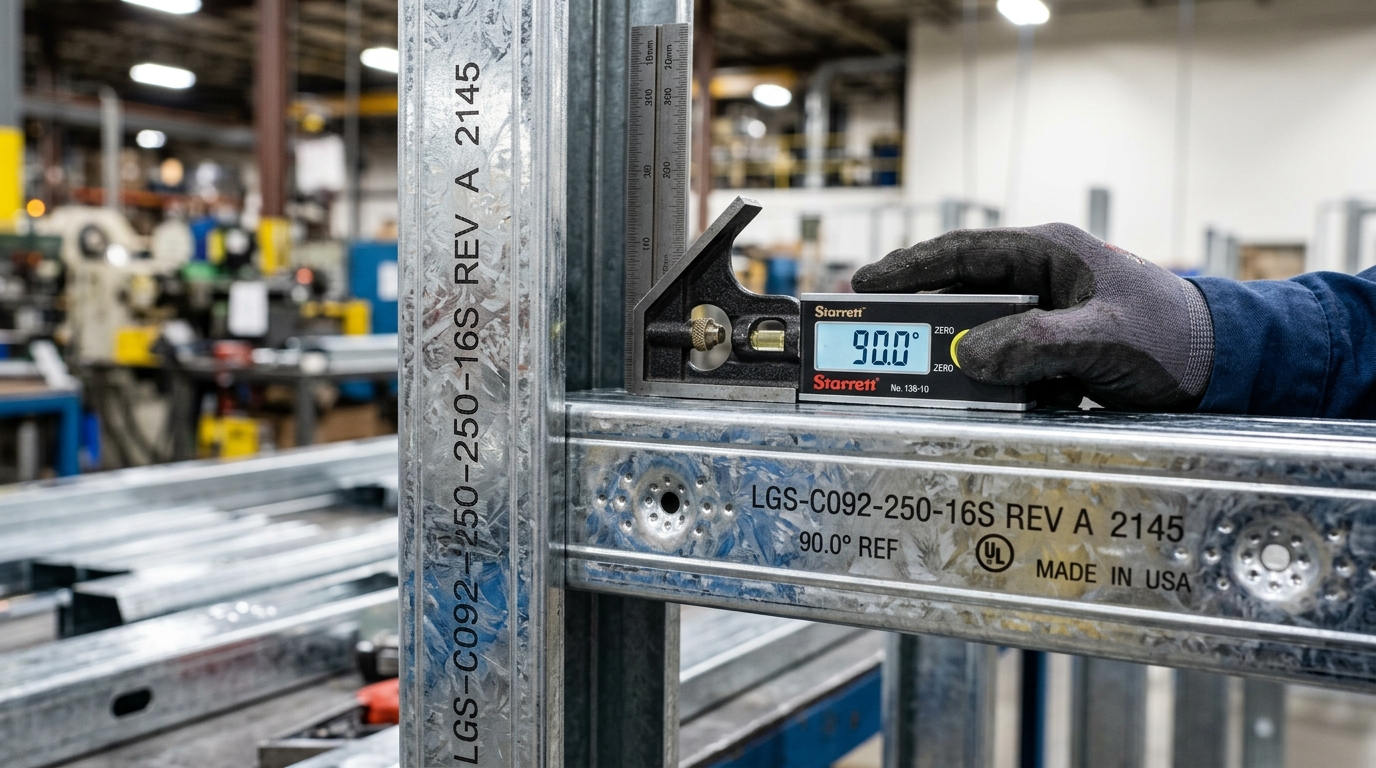
Cold-Formed Steel framing does not grow in the forest; it is precision-engineered from prime structural grade steel coil conforming to ASTM A653 / A1003. Computer-controlled roll-forming machines shape flat sheet steel through sequential roller dies into rigid structural C-sections with returned stiffening lips.
Every SteelFrameBuilds stud is produced with tolerances of ±1/16 inch (1.5 mm) across entire wall lengths. There is no crown. There is no crook. There is no rotational twist. When our steel studs are locked into floor and ceiling tracks, walls are mathematically plumb, level, and square from day one to year one hundred.
Zero Jobsite Cull Waste: 100% Usable Material
When purchasing timber, general contractors must routinely budget an additional 15% to 20% in board footage to account for warped, split, knot-ridden, or wane-damaged studs that end up in the dumpster. In California, disposal fees for construction and demolition (C&D) waste exceed $85 to $120 per ton.
With SteelFrameBuilds LGSF kits, every single component is engineered, CNC pre-cut, dimpled, and numbered according to the 3D BIM model. Jobsite scrap is under 1%, framing assembly progresses 40% to 50% faster, and framing crews never spend another billable hour sighting crowns or straightening warped lumber with saw kerfs.
Frequently Asked Questions
Q: What causes wood studs to crown, bow, and twist on the job site?
A: Trees grow with spiraling fiber grain, reaction wood (compression wood in softwoods), and juvenile wood near the core. As water evaporates unevenly across these grain densities, high internal stresses twist the stud along its longitudinal axis and bow it across its wide face.
Q: What is the standard jobsite cull rate for dimensional lumber?
A: Framing contractors typically experience a 10% to 18% cull rate when sorting through lumber bundles. Bowed, crowned, or knotted boards must either be discarded or reserved for short blocking, creating significant material waste and labor downtime.
Q: How does Light Gauge Steel Framing ensure laser-straight walls?
A: LGSF C-studs are manufactured via automated computer-controlled (CNC) roll-forming machines conforming to ASTM C955 and AISI S100 standards. Stiffened return lips and engineered web dimples lock the profile into a dead-straight planar alignment with tolerances within ±1/16 inch.
Q: Does SteelFrameBuilds supply pre-assembled steel panels in California?
A: Yes. SteelFrameBuilds manufactures both pre-cut, dimpled frame kits and pre-assembled structural wall panels with stamped engineering calculations throughout the greater Los Angeles metropolitan area and 100-mile radius.
Expert Light Gauge Steel Framing Across Los Angeles & 100-Mile Radius
SteelFrameBuilds (Skill See Services Inc.) is Southern California's recognized leader in Cold-Formed Steel (CFS) engineering and Light Gauge Steel Framing (LGSF). Operating under California State Contractor License CSLB #1110475 (Class B General Building), SteelFrameBuilds executes complete structural framing, pre-engineered CNC frame kit fabrication, and seismic value-engineering across an exact 100-mile operational radius centered in Los Angeles.
Our licensed service territory encompasses all major municipalities across five Southern California counties:
- Los Angeles County: Los Angeles, Long Beach, Pasadena, Glendale, Santa Clarita, Lancaster, Palmdale, Torrance, Inglewood, Beverly Hills, Santa Monica, Malibu, Burbank, Compton, West Covina, El Monte, Downey.
- Orange County: Anaheim, Santa Ana, Irvine, Huntington Beach, Newport Beach, Fullerton, Garden Grove, Orange, Costa Mesa, Mission Viejo, Laguna Beach.
- Inland Empire (Riverside & San Bernardino): Riverside, San Bernardino, Fontana, Moreno Valley, Rancho Cucamonga, Ontario, Corona, Temecula, Murrieta, Rialto, Victorville.
- Ventura County: Ventura, Oxnard, Thousand Oaks, Simi Valley, Camarillo, Moorpark.
- Santa Barbara County (100-Mile Corridor): Santa Barbara, Carpinteria, Montecito, Goleta.
Every framing assembly conforms strictly to the California Building Code (CBC 2026), LADBS Seismic Standards (Categories D-F), AISI S100 / S240, and Title 24 Energy Efficiency requirements. Whether you need pre-engineered ADU kits or full multi-family framing:
Direct Engineering Phone: (213) 394-9262
Official Email: info@steelframebuilds.com
Free Plan Review & Bid: SteelFrameBuilds.com/contact.html
Explore the 6-Part Wood vs. LGSF Engineering Series:
- Part 1: Wood Shrinkage vs. LGSF Stability (Why Walls Drop 3/4 Inch)
- Part 2: Bowing, Crowning & Twisting (Wood Distortion vs. 1/16-Inch Precision)
- Part 3: Dry Rot & Fungal Decay (Serpula Lacrymans vs. G90 Zinc)
- Part 4: Termite Immunity (Why California Pests Can't Touch Steel)
- Part 5: Seismic Base Shear V = Cs × W (Earthquake Physics in Zones D-F)
- Part 6: Structural Creep & Beam Sag (Viscoelastic Wood vs. Hooke's Law)