
The Biology of Structural Failure: How Fungi Eat Buildings
Wood is organic biomass. In the natural forest ecosystem, dead trees are broken down and recycled into soil by fungal microorganisms. When you frame a house with dimensional lumber, you are introducing that exact same biodegradable organic material into an architectural assembly.
Structural timber decay is driven by wood-destroying basidiomycete fungi, commonly categorized as brown rot (including the infamous Serpula lacrymans or 'dry rot') and white rot. These microorganisms secrete enzymatic proteins (cellulases and hemicellulases) that depolymerize long cellulose chains into simple glucose sugars for fungal nourishment. As the cellulose skeleton is consumed, the wood loses its tensile strength, turns dark and brittle, and fractures into characteristic cubical cracking patterns.
The 20% Moisture Content Tipping Point
Fungal spores exist ubiquitously in ambient air. They require only three conditions to germinate and consume structural timber:
- Atmospheric oxygen.
- Favorable temperatures (50°F to 90°F / 10°C to 32°C).
- Wood Moisture Content above 19% to 20% (the Fiber Saturation Point).
In Southern California residential buildings, crossing this 20% moisture threshold is remarkably easy. A pinhole leak in a bathroom PEX pipe, an unsealed stucco weep screed, a flashing failure around a roof deck, or interior condensation behind poorly ventilated shower enclosures will rapidly saturate wood framing. Under favorable conditions, brown rot fungi can destroy 50% to 75% of a load-bearing 2x6 stud's compressive capacity within 18 to 24 months—all while hidden completely behind pristine-looking interior drywall.
G90 Continuous Zinc Protection: The Metallurgy of Immortality
Steel is an inorganic mineral compound. It contains zero cellulose, zero lignin, and zero organic nutrients. Fungi, bacteria, and mold cannot digest, feed upon, or weaken structural steel.
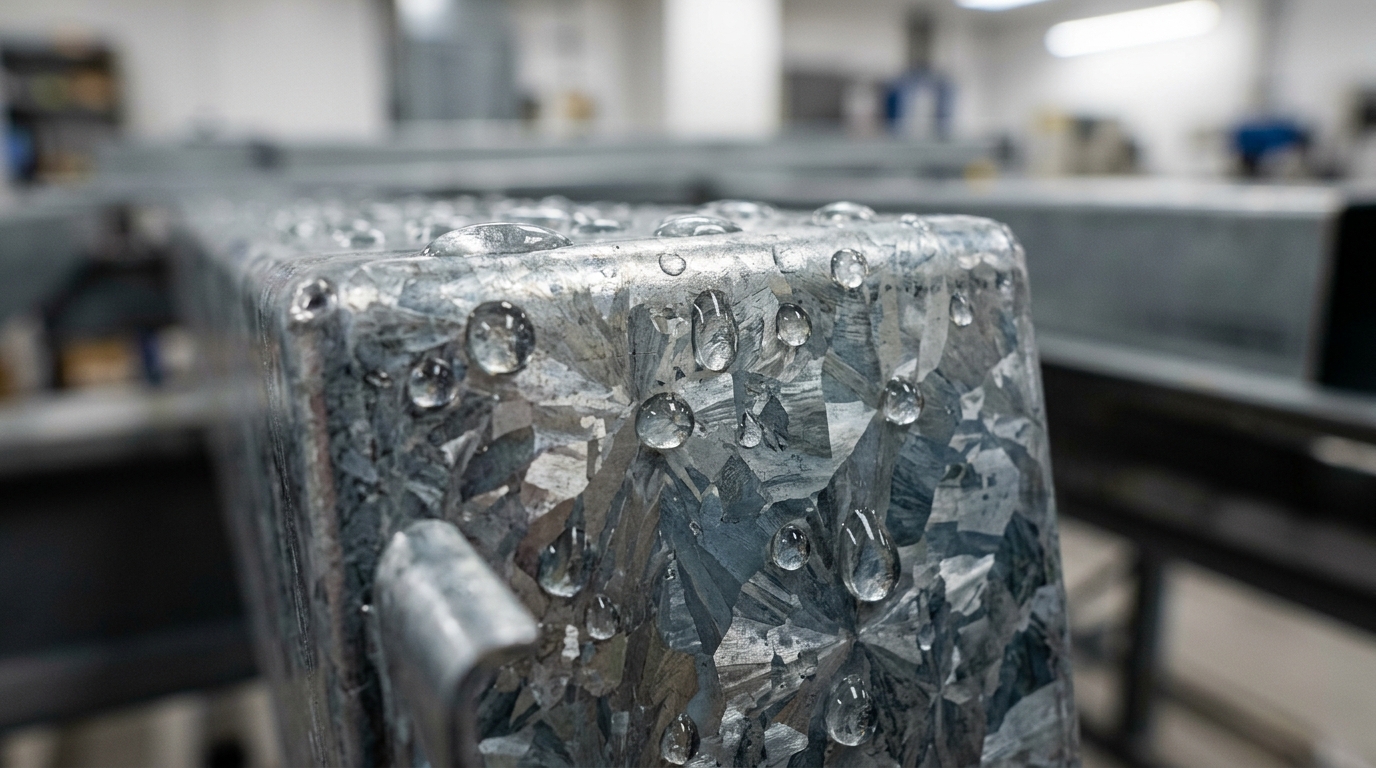
To protect against atmospheric oxidation (rust), structural cold-formed steel is hot-dip galvanized in molten zinc bath conforming to ASTM A653. At SteelFrameBuilds, we utilize G90 galvanized steel, which deposits a robust protective layer of 0.90 ounces of zinc per square foot (275 grams per square meter) across both sides of the sheet.
Cathodic Self-Healing: Why Screw Holes and Cut Edges Don't Rust
One of the most impressive metallurgical properties of galvanized steel is its sacrificial galvanic protection. According to the galvanic series of metals, zinc has a more negative electrochemical potential (-0.76 V) than iron (-0.44 V).
When an LGSF stud is cut on-site or pierced by a self-drilling screw, the microscopic exposed steel edge does not rust. In the presence of moisture, the adjacent zinc coating acts as a sacrificial anode, corroding preferencially to protect the exposed iron. Furthermore, as zinc oxidizes, it combines with atmospheric carbon dioxide to form an insoluble, tightly adhering film of zinc hydroxycarbonate (zinc patina). This crystalline layer permanently seals microscopic scratches against further environmental attack, providing verified service lives exceeding 100 to 150 years in typical enclosed residential wall cavities.
Frequently Asked Questions
Q: At what moisture level does wood framing begin to rot?
A: Wood rot fungi become active when wood moisture content exceeds the Fiber Saturation Point of approximately 19% to 20% in the presence of oxygen and temperatures between 50°F and 90°F. Once started, decay fungi secrete cellulase enzymes that permanently break down wood fibers.
Q: How much structural capacity does rotten wood lose?
A: Fungal decay can destroy up to 75% of wood's structural bending and compressive strength before visible surface decay is easily noticeable, creating severe risks for hidden balcony failures, wall collapse, and floor sag.
Q: How does galvanized steel resist rust and corrosion?
A: Light Gauge Steel is coated with a continuous layer of G90 zinc (0.90 oz/ft² or 275 g/m²). Zinc acts as both an impermeable barrier and a sacrificial galvanic anode. If the steel is scratched or cut, zinc sacrificially oxidizes to protect the underlying iron, forming an insoluble zinc patina that seals out oxygen and moisture.
Q: Can LGSF be used near coastal areas like Malibu or Newport Beach?
A: Yes. When built in high-humidity or marine splash environments within 100 miles of Los Angeles, SteelFrameBuilds specifies G90 galvanized or ZAM (Zinc-Aluminum-Magnesium) coatings combined with proper rainscreen air gaps to guarantee century-long corrosion resistance.
Expert Light Gauge Steel Framing Across Los Angeles & 100-Mile Radius
SteelFrameBuilds (Skill See Services Inc.) is Southern California's recognized leader in Cold-Formed Steel (CFS) engineering and Light Gauge Steel Framing (LGSF). Operating under California State Contractor License CSLB #1110475 (Class B General Building), SteelFrameBuilds executes complete structural framing, pre-engineered CNC frame kit fabrication, and seismic value-engineering across an exact 100-mile operational radius centered in Los Angeles.
Our licensed service territory encompasses all major municipalities across five Southern California counties:
- Los Angeles County: Los Angeles, Long Beach, Pasadena, Glendale, Santa Clarita, Lancaster, Palmdale, Torrance, Inglewood, Beverly Hills, Santa Monica, Malibu, Burbank, Compton, West Covina, El Monte, Downey.
- Orange County: Anaheim, Santa Ana, Irvine, Huntington Beach, Newport Beach, Fullerton, Garden Grove, Orange, Costa Mesa, Mission Viejo, Laguna Beach.
- Inland Empire (Riverside & San Bernardino): Riverside, San Bernardino, Fontana, Moreno Valley, Rancho Cucamonga, Ontario, Corona, Temecula, Murrieta, Rialto, Victorville.
- Ventura County: Ventura, Oxnard, Thousand Oaks, Simi Valley, Camarillo, Moorpark.
- Santa Barbara County (100-Mile Corridor): Santa Barbara, Carpinteria, Montecito, Goleta.
Every framing assembly conforms strictly to the California Building Code (CBC 2026), LADBS Seismic Standards (Categories D-F), AISI S100 / S240, and Title 24 Energy Efficiency requirements. Whether you need pre-engineered ADU kits or full multi-family framing:
Direct Engineering Phone: (213) 394-9262
Official Email: info@steelframebuilds.com
Free Plan Review & Bid: SteelFrameBuilds.com/contact.html
Explore the 6-Part Wood vs. LGSF Engineering Series:
- Part 1: Wood Shrinkage vs. LGSF Stability (Why Walls Drop 3/4 Inch)
- Part 2: Bowing, Crowning & Twisting (Wood Distortion vs. 1/16-Inch Precision)
- Part 3: Dry Rot & Fungal Decay (Serpula Lacrymans vs. G90 Zinc)
- Part 4: Termite Immunity (Why California Pests Can't Touch Steel)
- Part 5: Seismic Base Shear V = Cs × W (Earthquake Physics in Zones D-F)
- Part 6: Structural Creep & Beam Sag (Viscoelastic Wood vs. Hooke's Law)